
Galt Previous Residents: Era Map
A past-resident search needs the right source for the right era. The Recorder index reaches back to 1849, but the image is not online. The current secured roll is available through offline Assessor channels, while historic assessment series were not verified. Census schedules reach through 1950. The 1890 Great Register bridges the destroyed federal census. Galt permits date recent work, and a verified city or reverse directory would add annual occupants if staff confirms one.
| Source | Years covered | Where held | What it shows |
|---|---|---|---|
| Galt Recorder General Index | Since 1849 | Online index; images office or order | Galt ownership parties and document placement |
| Galt Recorder documents | Viewable from 1850 | Recorder office or copy order | Galt legal description, signatures, deed terms |
| Galt assessment roll and maps | Current; historic series unverified | Assessor lobby or request | Owner, APN, situs, mailing, assessment clues |
| Galt federal census | Through 1950 | NARA and library databases | Household, relationship, age, address, occupation |
| Galt 1890 Great Register | 1890 | FamilySearch film or DGS | Voter address, precinct, naturalization clue |
| Galt permit reports | 2024-2025, January-June 2026 seen | Galt Building Division | Recent construction or demolition dates |
| City or reverse directories | Not verified for Galt | CSL or Sacramento Room inquiry | Annual occupant bridge if a title is confirmed |
Galt owners are not the same as all previous residents. Add Galt household sources after the deed chain, then mark each fact as owner, occupant, heir, party, or address clue.
Galt Previous Residents Start With Today's APN
Enter the present Galt address in the Sacramento County Assessor Parcel Viewer. Save the 14-digit Galt APN, situs, subdivision, lot-block, map, values, and recorder page. The online viewer hides owner names, so request the Galt secured owner, co-owner, care-of, mailing, exemption, deed, and land-use fields at an Assessor lobby computer or through focused NextRequest.
Compare Galt situs and mailing without treating either as proof of occupancy. A Galt homeowner exemption is only a clue. A Galt mailing address can locate an absentee owner, while other household members ordinarily do not appear on the parcel roll. This first step tells the Galt previous-resident search which land record to follow, not who lived there in every year.
The Sacramento County Parcel Viewer supplies the current Galt parcel start. Preserve a screenshot or note of the Galt search date because the map and assessment data can update later than a deed.
Galt Deed Records: Grantor to Grantee
Once the current Galt owner is obtained, follow the acquisition deed in the Sacramento County Recorder index. Search the Galt owner as grantee, use the approximate recording year, APN, legal description, or recorder page, and identify the Galt seller as grantor. Then search that seller as an earlier grantee. Repeat until the Galt legal description or jurisdiction changes.
- Confirm the present Galt address, APN, subdivision, lot-block, and situs in the parcel viewer.
- Obtain the current Galt owner and mailing fields through the Assessor's offline channel.
- Find the Galt acquisition deed in the Recorder index by party, year, APN, or placement field.
- Copy Galt grantor, grantee, recording and execution dates, document number, legal description, and deed type from the image.
- Search the prior Galt grantor as an earlier grantee, separating title transfers from deeds of trust and reconveyances.
- When a Galt APN changes, use the plat, lot-line or merger record and legal description to carry the chain back.
- Grantor
- The Galt person or entity conveying an interest in the recorded instrument.
- Grantee
- The Galt person or entity receiving that interest.
- Chain of title
- The linked Galt sequence of transfers that explains ownership over time.
- Legal description
- The Galt land description in the deed, often more durable than a street number.
Galt Previous Residents: Order the Deed
The Galt online recorded-document index is a finding aid. It reaches back to 1849, but it does not expose the full deed image. The Recorder says Galt documents from 1850 onward may be viewed at an office. A noncertified copy costs $8 for the first page and $1 for each additional page. A certified copy costs $9 for the first page and $1 for each additional page. A self-service office copy is $1 per page.
The Galt mail or fax order form allows up to three records and asks for document title, book or page, certified or noncertified choice, copies, requester contact, shipping, and payment. Fax is 916-874-0947, and the order goes to the American River Drive office. A card adds $6, expedited delivery adds $19, and expedited delivery does not go to a PO box. Current Galt fees control.
Use the Sacramento County recorded-document copy page before ordering a Galt deed. The captured ordering source is shown below.
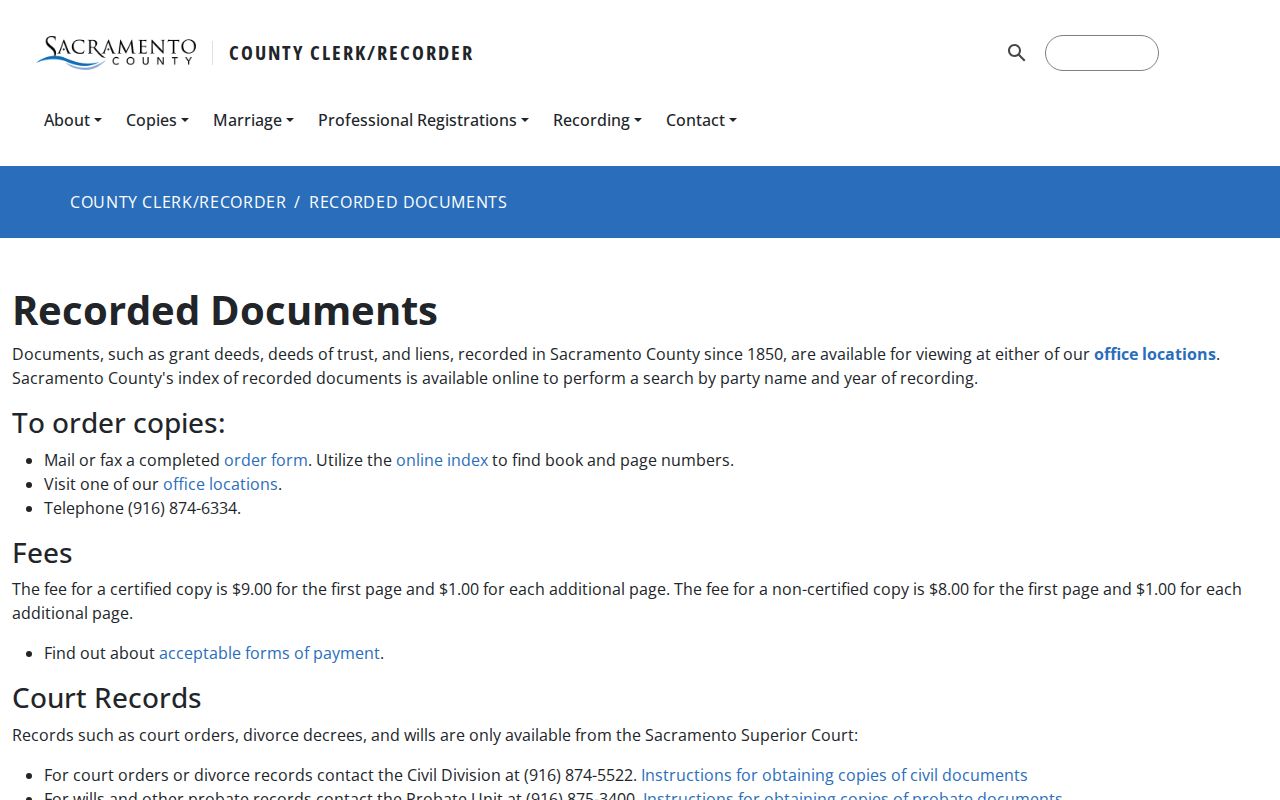
The Galt image is the practical bridge from a name-only index to the legal description and signatures needed for a house history.
Galt Previous Residents and APN Changes
APNs can change after parcel divisions, mergers, lot-line changes, or tax-rate actions. A modern street address may also be assigned or updated. Do not stop a Galt previous-resident search when an older deed has a different APN or number. Compare the subdivision, lot and block, map, grantor, grantee, recording date, and legal description. Plats and lot-line records can connect the old and new parcel.
The Recorder does not advertise street address as its strongest Galt key. Party name, APN, current owner, recording year, and legal description are better search bridges. A Galt deed of trust or reconveyance can sit between title transfers and should not be counted as a new owner. Tax bills can confirm assessment status, but they do not prove residence.
When the chain crosses an old Galt jurisdiction, note whether the record uses Dry Creek Township, Liberty, a city label, or a county description. The Galt place name is part of the evidence.
Galt Previous Residents in Census and Directories
Galt ownership is only half of a previous-resident trail. The Galt 1950 census is the newest public federal census, and schedules from 1850 onward can name household members, age, birthplace, marital status, occupation, and street or address details. A verified city or criss-cross directory can add annual occupant clues, but no Galt directory run or actual local entry was confirmed. The California State Library and Sacramento Room should verify title, years, publisher, reverse arrangement, and copy rules.
Pair a Galt directory year near 1950 with the census. Use the directory for the printed address and the census for relationships. A Galt newspaper, obituary, marriage index, probate file, or cemetery inquiry can explain a disappearance. The historical collection itself is covered on the Galt city directories page, while the present parcel chain stays with the Galt address record.
Do not call a general platform date range a Galt volume. Preserve a Galt catalog title or staff confirmation before citation.
Galt Previous Residents: 1890 Great Register
Most 1890 federal census schedules were destroyed after a 1921 Commerce Department fire. Sacramento County's 1890 Great Register can bridge the gap for a Galt-area voter. FamilySearch identifies film 2200427 and DGS 5030505. The Galt register may give a name, address, precinct, and naturalization court, date, or place.
It is not a full Galt household roll. It reflects registration and eligibility, and a precinct address still needs a second anchor. Search with Galt, Liberty, Dry Creek, or the relevant predecessor place, then compare the result with a deed, marriage, newspaper, cemetery, or later census. Exact spelling matters because the register is an old index, not a modern name search.
Use the FamilySearch Great Register catalog or ask a library or archive for film access. A catalog film may be easier to reach through a staffed research desk than a general web search.
Galt Previous Resident Records: Permit Dates
Galt Building Division monthly issued-permit reports cover 2024, 2025, and January through June 2026 in the research capture. They can date a recent Galt construction or demolition event tied to an address. The Galt iWorQ portal is an application workflow, not a public historic permit search. The report columns and any person-name field were not verified because the PDFs returned access errors.
For an older house, ask the Building Division for permit ledgers, plans, inspection cards, and closed files by exact address or APN through CPRA. Code Compliance at 380 Civic Drive can receive a focused request for a case log or closed file by address and date. Sensitive complainant or enforcement material may be withheld.
A Galt permit can explain when a structure changed. It cannot by itself name every past resident or prove that the applicant occupied the address.
Galt Previous Residents: Marriage and Probate
A Galt past resident trail often closes with a relationship record. Sacramento County marriages reach back to 1850 at the county level, while FamilySearch lists a California County Marriages collection from 1849 to 1957 and a California Marriage Index from 1960 to 1985. Public and confidential marriage copies have different eligibility rules. An index entry can supply a spouse, date, or place, while the Galt custodian supplies the official copy.
A Galt obituary can name relatives and former places. Galt probate can add petitioner, heir, devisee, counsel, and filed-address clues. Galt-Arno Cemetery District operates Galt and Hicksville and accepts phone inquiries; GAHS research identifies Liberty Cemetery beginning in 1852 and Elliott in 1859. A Galt cemetery confirmation can separate two same-name people and give a final date for the chain.
The Sacramento County marriage-record page is the official access point shown below.
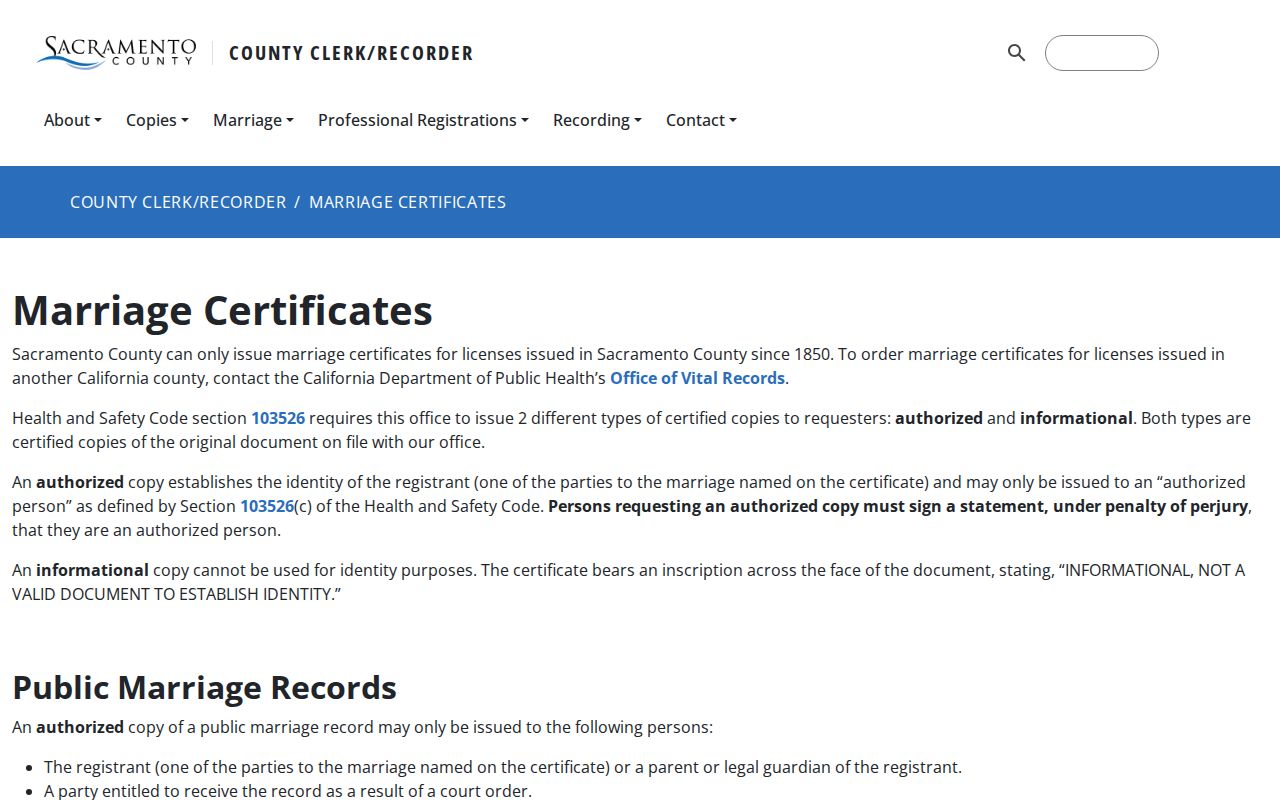
Use a Galt marriage record as a relationship clue, then check the deed, obituary, probate, or cemetery source that supports the address link.
Galt Previous Residents: Liberty Before 1869
Galt was laid out as a rail town in 1869 after earlier settlement near Dry Creek. Liberty's post office changed when the railroad chose the Galt stop. An early past resident may therefore appear under Liberty, Dry Creek Township, or a broader county label rather than a modern Galt address. Search those place names before deciding that a household disappeared.
The original Galt street grid paralleled diagonal tracks. A Galt historic legal description can look unlike a current map while still describing the same land. Compare railroad-oriented maps, subdivision or lot-block language, Recorder images, and cemetery or newspaper references. No verified street-renumbering year was found, so do not invent one.
Galt Previous Residents: Sanborn Map Check
Galt Digital Sanborn Maps on the Sacramento Public Library platform are dated 1867 to 1970. They can show a building footprint, use, and sometimes a name when the exact Galt sheet exists. The research did not verify a Galt sheet or title. A platform range is not proof that a particular address appears.
Search the Galt library catalog or ask the Sacramento Room for a title-level check. Compare any Galt map sheet with the legal description, parcel map, and deed image. Fire-insurance map notation can explain a structure while the deed chain explains land ownership. Keep those evidence types separate.
Galt Sanborn material is a useful house-history lead, not a substitute for the Recorder, Assessor, census, or a verified directory.
Galt Previous Residents Need Lawful Context
Galt previous residents research is strongest when it explains a house, a family line, a deed, or a local history. It should not become a way to track a living person. Public sources can be stale, a deed can name an absentee owner, and a historical address can lead to a current Galt parcel with a different household. Safe at Home and other protected records may hide people by design.
Lawful use. Use Galt past-resident records for house history, genealogy, reconnecting, and personal research. Do not use an address trail to stalk, harass, intimidate, or expose anyone. Verify a record with its custodian before relying on it.
The best final Galt note is often a source note: what was found, what was not found, which year is missing, and which office or library could answer next.